
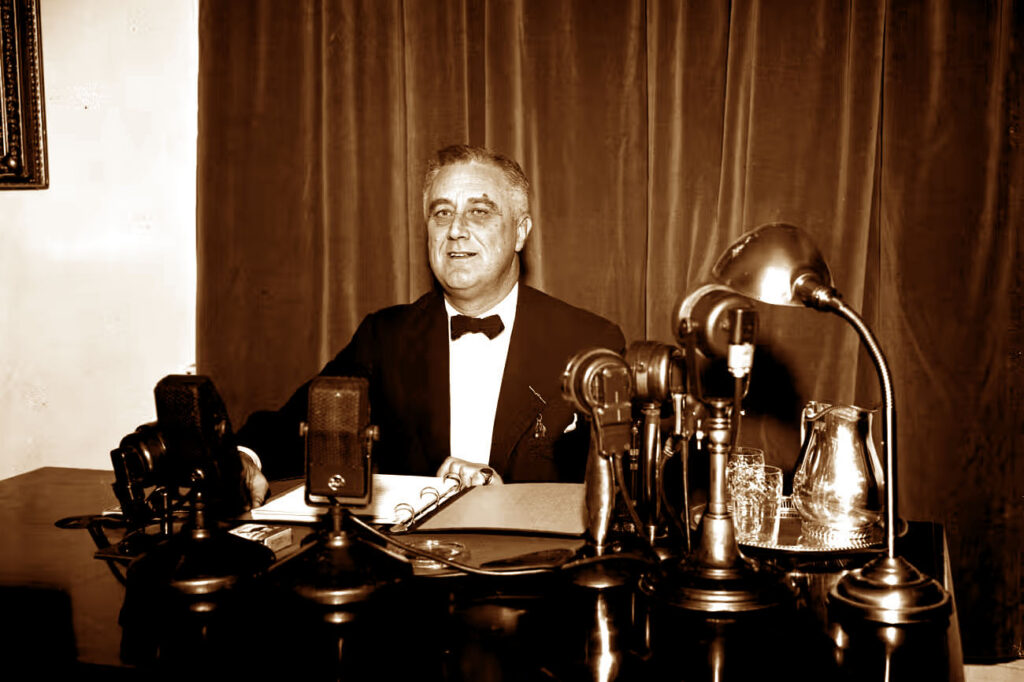
1933| Franklin Delano Roosevelt. (Photo/Courtesy White House Historical Association)
LESSONS FROM 1933: WHY EMPATHY MATTERS JUST AS MUCH AS CRANES IN A CATASTROPHE
Jesús Sánchez Meleán
Haga click aquí para leer la versión en español
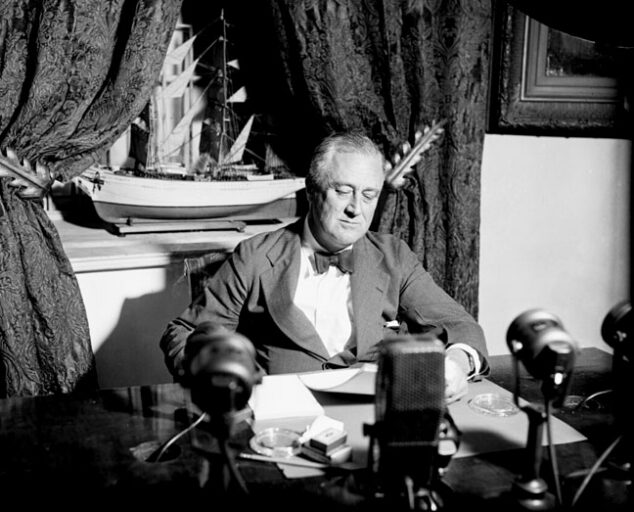
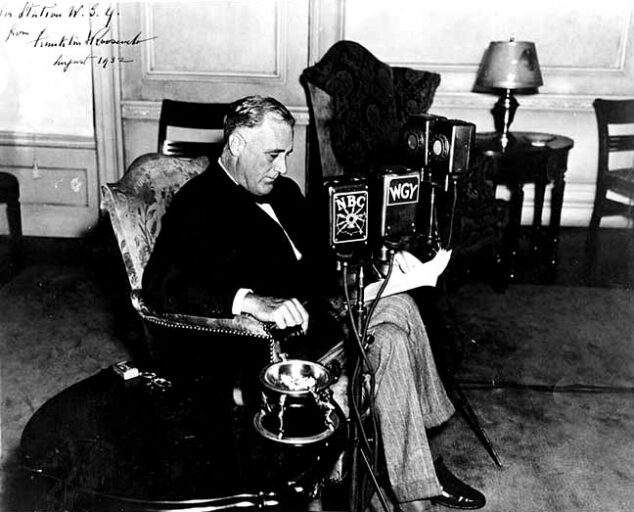
On the night of Sunday, March 12, 1933, about ten million Americans sat in front of their radios to listen to their newly sworn-in president, Franklin D. Roosevelt. The country was at the lowest point of the Great Depression. The banking system had collapsed, hunger and unemployment were hitting families hard, and social panic dominated the streets.
In what would become the first of his famous “fireside chats,” Roosevelt did not resort to technicalities or empty promises. With a voice that combined authority and closeness, he explained in simple terms how banks operated and why citizens’ money would be safer in a reopened financial institution than under the mattress.
Everything is Under Control
That exercise in mass communication aimed not only to explain economic decrees, but to absorb collective anxiety and restore a sense of control to the people. The following day, when banking institutions opened their doors after a temporary suspension, people did not rush to withdraw their savings, but to deposit them.
Roosevelt understood before anyone else that, in the midst of a deep crisis, the provision of material resources is just as critical for survival as institutional psychological containment, effectively acting as a comforter-in-chief capable of preventing fear from paralyzing society.
Venezuela Searches for Someone to Restore Its Hope
From 1933 to 2026
Nearly a century later, the landscape of devastation that Venezuela faces today offers a crisis scenario radically different from the financial collapse of the 1930s, but with an equally paralyzing human and structural impact. The double seismic event of this past June 24, consisting of two consecutive earthquakes with magnitudes of 7.2 and 7.5 Mw and epicenters in Yaracuy, destroyed the north-central strip of the nation in a span of barely three minutes.
Preliminary assessments expose the magnitude of one of the region’s largest natural disasters. The United States Geological Survey (USGS) estimates initial material damages between 6.7 and 12 billion dollars, while NASA’s satellite radar analyses confirm that nearly 59,000 buildings were damaged or destroyed.
High Cost in Lives
Official figures already exceed 2,000 fatalities, but the true drama lies in the mass of more than 60,000 missing persons who remain reported as location pending among the rubble and cut-off areas. United Nations agencies estimate that close to 6.8 million people have been directly or indirectly affected by the tragedy, compromising the food security and basic services of nearly a quarter of the country’s population.
In the face of the emergency, strictly material and economic operations are slowly trying to make headway. Rescue teams from twelve countries and shipments of international humanitarian assistance have deployed on the ground. Nonetheless, experts point out that essential massive debris removal efforts are barely beginning because the main port and air traffic to La Guaira suffered severe damage, strangling the entry of the specialized heavy machinery that is urgently needed.
A Traumatized Nation
To mitigate the immediate impact on the more than 15,000 people left homeless, the interim government of Venezuela speaks of financial relief that includes bonuses to cover living and food expenses, along with mortgage assistance plans destined to repair and build permanent housing. However, solving the logistical and economic aspects is only half the challenge.
Managing a catastrophe of this scale forces authorities to respond to an invisible but lethal danger. I am referring to the deep psychological fracture and national trauma of a population in shock. Following the institutional and physical collapse, Venezuelan society faces hopelessness, massive mourning, and collective fear in the face of absolute loss.
This is where Roosevelt’s historical lesson resurfaces. A solid, empathetic, and transparent institutional narrative is indispensable to channel passions, dispel panic, and mobilize citizens toward reconstruction. The main challenge lies in defining who will exercise that role of psychological and moral containment. It is easy to conclude that the current official leadership in Caracas lacks the necessary credibility and legitimacy for its messages of calm to be accepted without suspicion or skepticism.
Who is Going to Say “Everything is Going to Be Alright”?
At the same time, even if the United States or multilateral organizations provide advanced logistical and satellite support, the foreign imposition of a military or civil command structure is not necessarily enough to coordinate a nation’s psyche, given that true collective resilience can only be inspired by leaders who share the same cultural and emotional DNA as the affected population.
Only by allowing figures with high civil legitimacy to openly participate in the moral and logistical leadership of the disaster will the Venezuelan state be able to absorb the anxiety of families and trace a transparent roadmap that turns despair into coordinated action. While tons of rubble continue to occupy city streets, the reconstruction of the mental fabric and mutual trust will be the definitive foundation upon which Venezuela manages to rise.
Venezuela Searches for Someone to Restore Its Hope

You may also like:
Guest Columnist – Security, Dignity, and Truth: My Commitment to Immigration
A Living Cathedral for Humanity
Hickenlooper: “I am betting on profound changes in the U.S.”



otras noticias
Guest Column – Delivering for Colorado’s Latino Community and All Coloradans
Guest Column – A Boulder Optimist: Restoring Opportunity
Guest Column – Vote NO: Proposition 133 is a dangerous trap