

IN AURORA, COLORADO | Mexicans represent one-third of the total migrant population. (Photo/El Comercio de Colorado)
RADIOGRAPHY OF A GLOBAL CITY
Newsroom El Comercio de Colorado
Haga click aquí para leer la versión en español
The city of Aurora has established itself as one of the most diverse places in the United States, where one in five residents is an immigrant or refugee. This means that more than 80,000 foreign-born individuals have chosen this Colorado city as their home.
According to data from the report by the Institute for Immigration Research at George Mason University, the main countries of origin for this population are Mexico (36%), Ethiopia (7%), Korea (4%), El Salvador (3%), and Vietnam (3%). Joining them is a population originating from 120 other distinct nations. This mix of cultures is highly noticeable in daily life and language.
In fact, 32.8% of Aurora residents speak a language other than English at home. Spanish is the most common foreign language (47%), followed by Amharic (7%), Russian (3%), and Korean (3%). This reality is clearly reflected in Aurora Public Schools, where students speak more than 160 languages in the classroom.
Economic Achievements and Community Participation
To review the progress of integrating these communities, the Office of International and Immigrant Affairs (OIIA) analyzed the advancement of its ten-year strategic plan. The balance sheet of the first five years shows positive results for the local economy.
An important indicator is the entrepreneurship that these migrant communities bring. In 2025 alone, 25 small businesses led by foreign nationals opened in Aurora. Meanwhile, the “Global Entrepreneur Program” has directly advised 87 immigrant entrepreneurs.
Community participation has also grown significantly. More than 600 people completed their English courses for work and succeeded in being sworn in as U.S. citizens at City Hall. Additionally, the Aurora Fest festival welcomed about 10,000 people at its latest edition.
Migrant Community Driver Growth and Diversity in Aurora
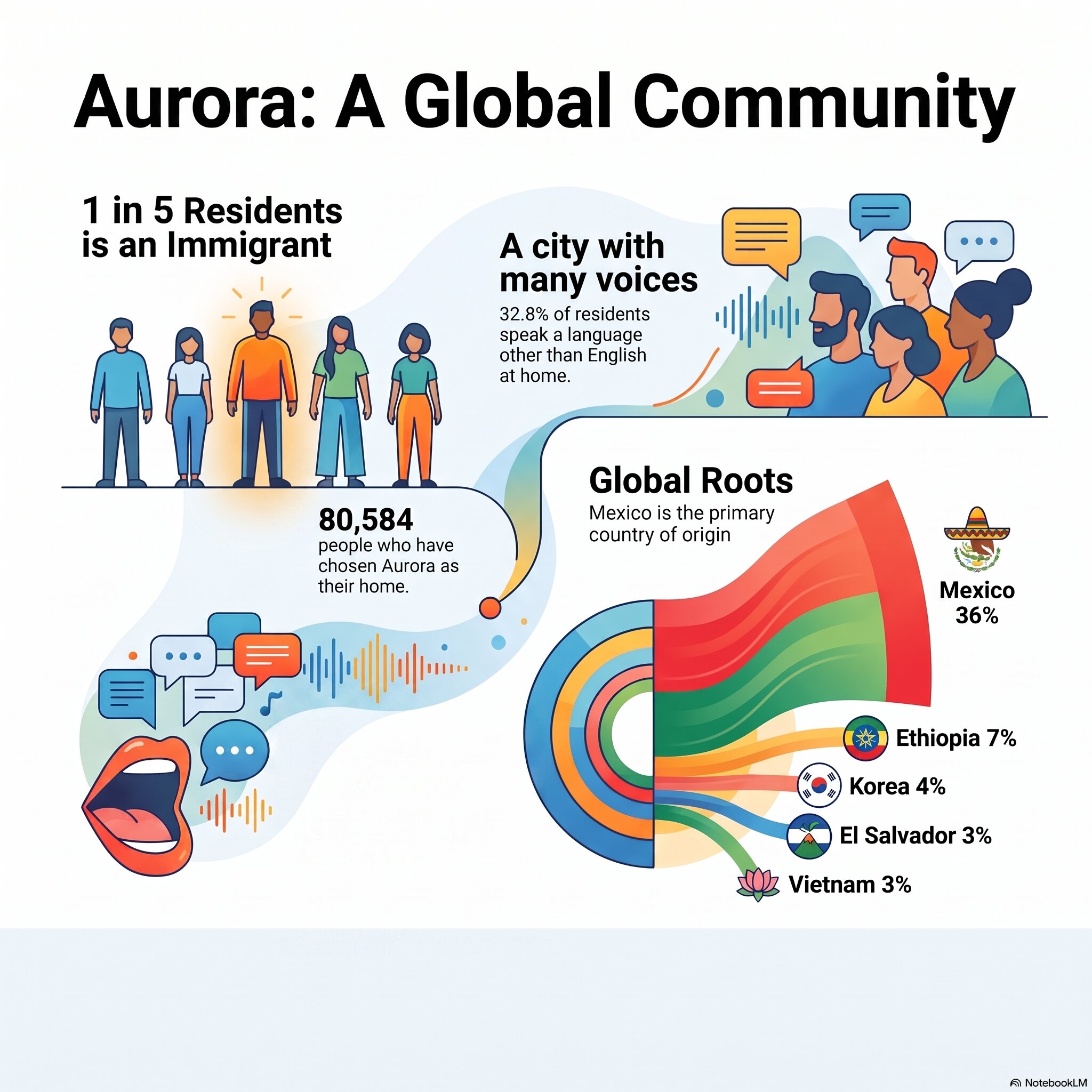
Integration Model
On the other hand, the “Natural Helpers” volunteer program has trained more than 700 neighbors who help other migrants connect with city services.
“The report’s results confirm that migrants and refugees residing in Aurora feel a significant sense of belonging,” said Ricardo Gambetta, director of OIIA.
Gambetta continued, “Aurora is one of the few cities in the U.S. with a comprehensive integration plan. Our actions are framed within that plan, and at the same time, we adapt strategies as we implement it and learn along the way.” This integration policy model has been awarded both nationally and internationally.
The Challenge of Informing
Despite the good results and the fact that more than 90% of survey respondents feel welcome in the city, the report identified areas that still need improvement. The primary issue is the lack of information. One in three foreign-born residents is unaware that these aid and integration programs and services exist.
Focus groups explained that immigrant families continue to rely on their neighbors, media outlets within their cultural communities, and information their children bring home from school. According to the report, the migrant population in Aurora places less trust in social media and government websites.
For the coming years, Aurora authorities committed to opening more English classes, as current demand exceeds available slots. Gambetta indicated that they also plan to create the “Welcome Pathway,” an orientation system designed to greet people arriving in the city independently outside of traditional resettlement programs with a friendly face.
Migrant Community Driver Growth and Diversity in Aurora
You may also like:
SOS Venezuela sends financial aid and coordinates humanitarian help in Venezuela
Major summer event with Latino flavor at Denver Botanic Gardens

otras noticias
Evans: “Conditions at GEO in Aurora Are Superior to What I Had When I Served in the Army”
Foul Odor and Chemical Symptoms Reported at GEO Aurora
Ron Montoya leaves an indelible mark on Colorado