
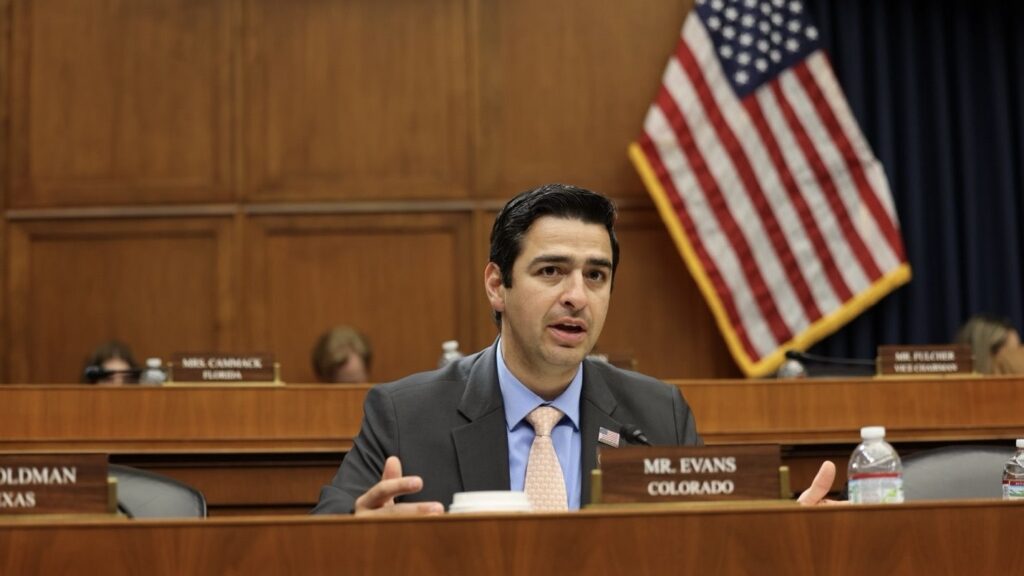
SAID THAT DEMOCRATIC SECTORS ARE USING THE IMMIGRATION ISSUE TO CAUSE FEAR.
Hours after meeting with DHS Secretary Markwayne Mullin, Congressman Gabe Evans accused Democratic sectors of using immigration to instill fear and defended the federal government’s management of the GEO migrant center in Aurora. “The housing, food, and healthcare conditions for detainees in Aurora are superior to what I had when I served in the Army,” the lawmaker stated.
Newsroom El Comercio de Colorado
Haga click aquí para leer la versión en español
El Comercio de Colorado: What is your conclusion after meeting with Secretary Mullin?
Representative Gabe Evans: Well, we held a roundtable together with Secretary Mullin and several faith leaders, specifically from the Hispanic community in the Denver area. We had pastors from churches in Greeley and Evans, as well as from the Denver metropolitan area. We wanted to give community faith leaders the opportunity to ask me questions, but also to listen to and directly question Secretary Mullin on any topic they wanted.
The conversation mainly revolved around two axes. First, how the Department of Homeland Security (DHS)—which oversees ICE—pursues criminals and who their operations are targeted at; and second, what agencies like U.S. Citizenship and Immigration Services (USCIS)—which is in charge of visas and work permits—can do to help good people better navigate the system, obtain work permits, and maintain legal status.
ECC: Did Secretary Mullin offer information about migrant detentions like the one that occurred at Denver Airport a few days ago?
GE: Yes, that question was asked directly to him, and he clarified several points. First, anyone traveling by plane must go through the Transportation Security Administration (TSA), which is a federal law enforcement agency. There is a difference between having a final order of deportation and simply not having legal status. If you try to fly without legal status, TSA is going to flag you because that is literally their job: to verify that passengers at checkpoints have legal status.
In those cases, the Secretary pointed out that he has no alternative, as we are a nation of laws that we must follow, so the person will be detained. However, if their only violation is lacking legal status, they are generally granted a bond or parole and released with a court date to resolve their situation. He emphasized that we must follow the law; otherwise, we would be no different from the countries that many people flee due to a lack of the rule of law.
To fly, some form of legal status is required. This brings us back to the point we insisted on during the meeting. My office does not hand anyone over to ICE for deportation or law enforcement purposes. Our job is to help people process their legal status, communicate with USCIS, and manage work permits, visas, or DACA renewals. As proof of that, during that very same meeting, in a matter of two hours, I managed to contact the director of USCIS through Secretary Mullin to review a case presented by a pastor.
Thanks to that, we obtained a work permit for a person who had been waiting for several months. My office is here to help people obtain work permits and visas so they can travel through the airport legally and without fear.
Evans: “Conditions at GEO in Aurora Are Superior to What I Had When I Served in the Army”
ECC: Can a person with a valid work permit or active Temporary Protected Status (TPS) travel by plane or not?
GE: Those are two different things. A work permit by itself does not grant legal status. You can have a visa that allows you to be legally in the country but does not authorize you to work; or vice versa, have a work permit, but if the underlying visa or legal status has expired, you lack legal status. You must have formal legal status; a work permit in isolation does not always confer it, and that was something the Secretary emphasized. To board a plane, a visa or another form of legal status that complies with regulations is required.
ECC: Is a “temporary status” or a work permit without a visa not valid for air travel from that perspective?
GE: There are work permits associated with what is called “deferred status”. This applies when a person is in the process of obtaining a visa and, having no criminal record, the government grants a work permit with deferred status while the visa process is completed. There are many nuances in these situations.
Secretary Mullin’s recommendation and my message is that anyone with questions should contact my office. We do not hand anyone over to ICE. What we do is evaluate whether the specific combination of permits, visas, or deferred status a person holds allows them to travel legally by plane.
ECC: Do you have any comment regarding the upcoming operation of a new ICE facility in Hudson, northwest of Colorado?
GE: That topic was not addressed, but crime statistics were discussed. Colorado is part of the Rocky Mountain region for drug enforcement, along with Utah, Wyoming, and Montana. Although these four states represent only 4% of the national population, they account for 16% of the country’s fentanyl, with the vast majority located in Colorado. Unfortunately, Colorado is an epicenter of drug trafficking and one of the few states where overdose deaths continue to rise.
According to estimates by the Common Sense Institute, 1,600 more people would still be alive if Colorado had followed the national trend of declining overdose deaths. Since Colorado is a sanctuary state—a topic we also discussed—cartels and drug dealers find refuge here. Therefore, ICE’s focus is on going after drug distributors and fentanyl traffickers. We also talked about human trafficking. Colorado accounts for 10% of the country’s cases despite having only 2% of the population.
The Secretary detailed that this issue encompasses both sexual exploitation and forced labor operated by cartels. At the Aurora detention center I visited, 60% of the people in ICE custody have a criminal background or pending criminal charges. ICE’s goal is to remove criminals, drug dealers, and human traffickers from our communities.

Evans: “Conditions at GEO in Aurora Are Superior to What I Had When I Served in the Army”
ECC: Do you agree with the creation of more ICE detention centers in Colorado?
GE: The new ICE facilities in Colorado are intended to serve nationwide, not just the state. Their opening responds to the need to relieve overcrowding in other facilities across the country resulting from ICE’s priority focus on arresting criminals, drug dealers, and human traffickers.
ECC: In recent days, at least one confirmed case of tuberculosis was reported at the ICE detention center in Aurora, managed by GEO Group. As a result of that case, there is a disagreement between local health authorities and GEO over access to the facility. What is your stance on whether local health authorities should be allowed to inspect the GEO center?
GE: It is important to remember that the United States Constitution establishes the supremacy of federal law in areas under its jurisdiction. In Colorado, we have seen a political use of the immigration issue by Democratic sectors to create fear. As the only Hispanic member of the Colorado delegation and with my prior experience in law enforcement, I can point out that the ICE facility in Aurora receives approximately five times more inspections than the jails where American citizens are held for common crimes. Furthermore, Secretary Mullin confirmed that there are currently no tuberculosis cases at that facility.
ECC: Do you trust the management and reports of the Department of Homeland Security (DHS) regarding the health situation at the migrant center in Aurora?
GE: I have personally visited that facility, and I can affirm that the housing, food, and healthcare conditions for detainees in Aurora are superior to what I had when I served in the Army. Even the recreational and sports equipment exceeds what some high schools in the state have, as observed by the former mayor of Platteville during the tour.
ECC: Do you have a final message for the community?
GE: My office does not report anyone to ICE for deportation measures; we are here to help process legal status, clarify questions about air travel, and manage work permits or visas. I invite the community to contact us directly. There is misinformation motivated by political interests aimed at creating fear. For example, it is false that massive raids are being conducted in places like Home Depot.
The presence of ICE on Colorado streets is due to state laws prohibiting local jails from notifying or transferring individuals arrested for crimes such as car theft or drug trafficking—who also lack legal status—to ICE custody. Upon being released back into the community by state mandate, ICE agents must go back out to locate and rearrest these individuals.
ICE’s commitment is focused on pursuing those who commit crimes; therefore, we reiterate our call for the community to do things through legal channels and reach out to our office for guidance.
You may also like:
Ron Montoya leaves an indelible mark on Colorado
Crow: “The Ukrainian people are showing us the future of defense”
Major summer event with Latino flavor at Denver Botanic Gardens



otras noticias
Guest Column – Delivering for Colorado’s Latino Community and All Coloradans
Guest Column – A Boulder Optimist: Restoring Opportunity
Guest Column – Vote NO: Proposition 133 is a dangerous trap