
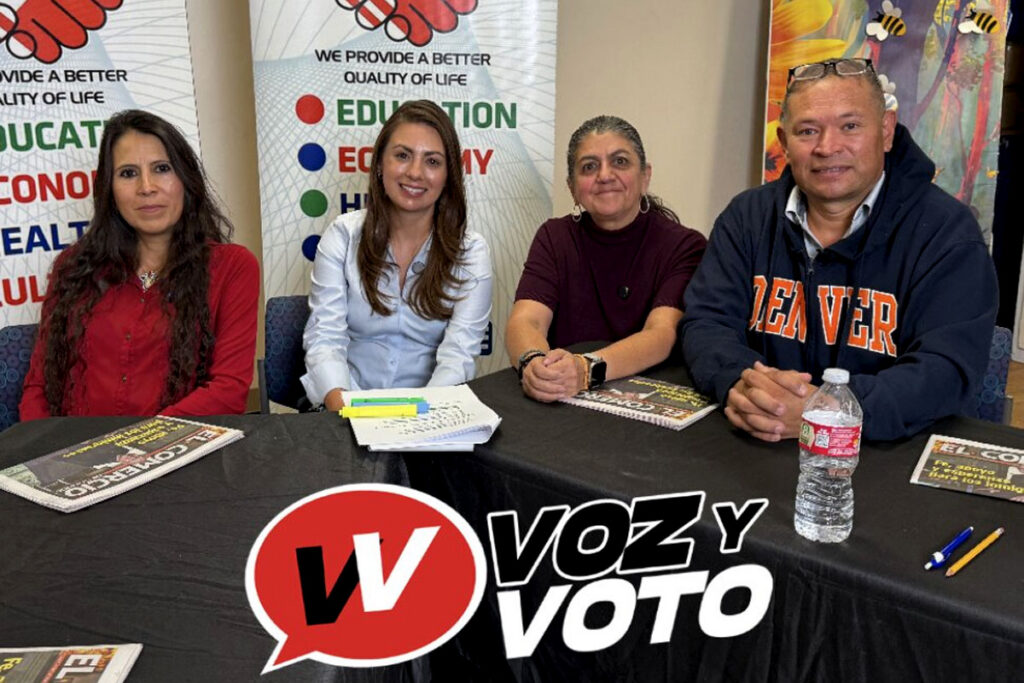
VOTERS IN DISTRICT 8 | Giuliana Day, Yadira Solís, Leticia Anaya, and Marden Platero. (Photo/ El Comercio de Colorado)
MEETING WITH VOTERS IN COLORADO’S 6TH DISTRICT
Newsroom El Comercio de Colorado
Haga click aquí para leer la versión en español
At the headquarters of the organization Amigos de México, located in the city of Aurora, four Hispanic voters from Colorado’s 6th Congressional District shared their concerns ahead of the November 3 elections. When evaluating legislative priorities, inflation and wages dominated the discussion. Yadira Solís stated: “For many in Colorado, and especially for the Latino community, the priority is the economy and being able to pay for our things”.
Regarding daily household expenses, Solís reported: “I have seen almost how my utility bills and my supermarket payments when I buy food have doubled recently. The funds to support my family are no longer enough”. For his part, Marben Platero, a construction worker, warned about the lack of decent compensation: “As a head of household, I say that my salary is not enough to cover the basic food basket… and it is also difficult to manage the purchase of supplies to be able to carry out my job”.
Deficient Transportation, Gas Costs, and Safety
Urban mobility also raised alarms. Leticia Anaya emphasized: “Here in Aurora we have a very deficient transportation system. People who don’t have a car and have to move from one place to another on public transit face problems. Transportation would be the priority for me for whoever represents this district in Congress”. Anaya detailed the impact of fuel prices: “Paying for gas has affected me a lot”.
Giuliana Day agreed on this point and linked it to safety. “The increase in gas prices has directly affected me because I travel through different areas all day. When the government does not provide that safety [in the stability of a staple such as gasoline] so that we can also run our businesses, that is going to affect the entire Latino community”.
Reverse or Maintain Changes to the Healthcare System?
When analyzing health coverage, all four participants called for structural reforms. Leticia Anaya shared her personal situation: “I was planning to retire next year, but when I see that I don’t have access to Medicaid until I turn 65, I said: well, I’m going to wait. They need to pass a good reform, really thinking about the people and not thinking about the pockets of those on the other side”.
Platero hopes that the changes to the healthcare system promoted by the administration and enacted into law by Congress can be evaluated to see whether or not they have had a positive impact on the people. The worker added: “Our political leaders must be proactive and not react only after the people are already being affected”. In turn, Day demanded that “all those funds truly go to people in need, because there is also a lot of corruption”.
Day also expressed her disagreement with the use of public funds to pay for abortion procedures. Solís voiced her disagreement with Day’s position. “I believe reproductive health encompasses Pap smears, breast cancer, and abortion. People must have access to all of that,” Solís stated. The young executive argued in favor of reversing the healthcare changes approved in the 2025 “Big Beautiful Bill”.
“The problem is that we are no longer going to have access to healthcare at a low cost or at a cost that a family can afford. Therefore, what should happen is that those changes be reversed, while also taking advantage of the moment to implement reforms for greater access to nutrition, mental health, and other areas,” she said. Solís likewise warned about the vulnerability created by tying health insurance to employment. “It limits us that our health plans are connected to our jobs,” she added.
Raids and Racial Profiling
The immigration debate reflected deep anxiety over raids and racial profiling. Solís acknowledged that, although she has not experienced direct discrimination, a latent fear persists in daily life. “I often think about what I would do if a police officer stops me at the airport, or stops me on the street, or while picking up my nephews at school. I live through that fear,” Solís shared. Regarding initiatives linking local police work with ICE, Solís warned that “we already have a legal process that takes place right now, and an amendment does not need to be added for this to happen and compromise our basic safety”.
Platero warned of the human toll: “There are mothers or fathers who are being left behind with families torn apart, homes broken… The people sometimes don’t have a voice, but the leaders always do,” Platero said. For her part, Anaya proposed paths toward work authorization: “I suggest that they create an immigration program where workers are allowed to enter with an identification so they can work, drive, and make a living”.

PLAZA COLORADO | Marketplace with small businesses serving the Latino community in District 8. (Photo/ El Comercio de Colorado)
A High-Income District
Colorado’s 6th District is home to 730,108 residents according to the 2024 American Community Survey, of whom 177,643 are Hispanic or Latino, representing 24.33 percent of the total population. Among the citizen voting-age population, the white population represents 66.5 percent, Hispanics account for 15.3 percent, and African Americans comprise 9.6 percent. The district has a median age of 37.6 years.
In terms of education, 44.8 percent of residents aged 25 and older hold a bachelor’s degree or higher, a rate above both state and national averages. Economically, the median household income stands at $103,252 per year. Its territory encompasses dense urban areas of Aurora as well as southern suburban communities across Arapahoe, Adams, and Jefferson counties.

FIVE CANDIDATES | Top row: Jason Crow (Democrat); Jason Clark (Republican); Meredith Ryan (Unity Party). Bottom row: Samir Ezzeldin Witta (Independent); Patty McMahon (Libertarian Party)
Candidates for district 8
Democrat Jason Crow is seeking his fourth reelection as representative for the 6th District in the federal Congress. Crow, a military veteran and attorney, has focused his platform on the affordability of the cost of living, lowering housing costs, and reversing the changes made by the Trump administration to healthcare programs.
Running on the Republican ticket is Jason Clark, an entrepreneur and West Point graduate who is promoting an agenda focused on rent relief, support for small businesses, and investments in public safety. The roster of candidates includes Libertarian Patty McMahon, a former official with the Equal Employment Opportunity Commission who proposes limiting government spending.
Also running is Meredith Ryan, nominated by the Unity Party on a platform of universal healthcare and environmental reform. The independent option is represented by Samir Ezzeldin Witta, a medical oncologist who proposes regulatory caps on rent and free healthcare for young people. The choice at the ballot box will define the legislative direction of a community characterized by significant occupational diversity.
You may also like:
Governor Polis Appoints María González to Fill Manny Rutinel’s Vacancy



otras noticias
Latina Voters Demand Halting Inflation, Slashing Regulations, and Reforming the Immigration System
Jenna Griswold: “I will stand up to the federal government to protect Colorado”
Michael Allen: “I will not be a puppet for Washington or the governor”