
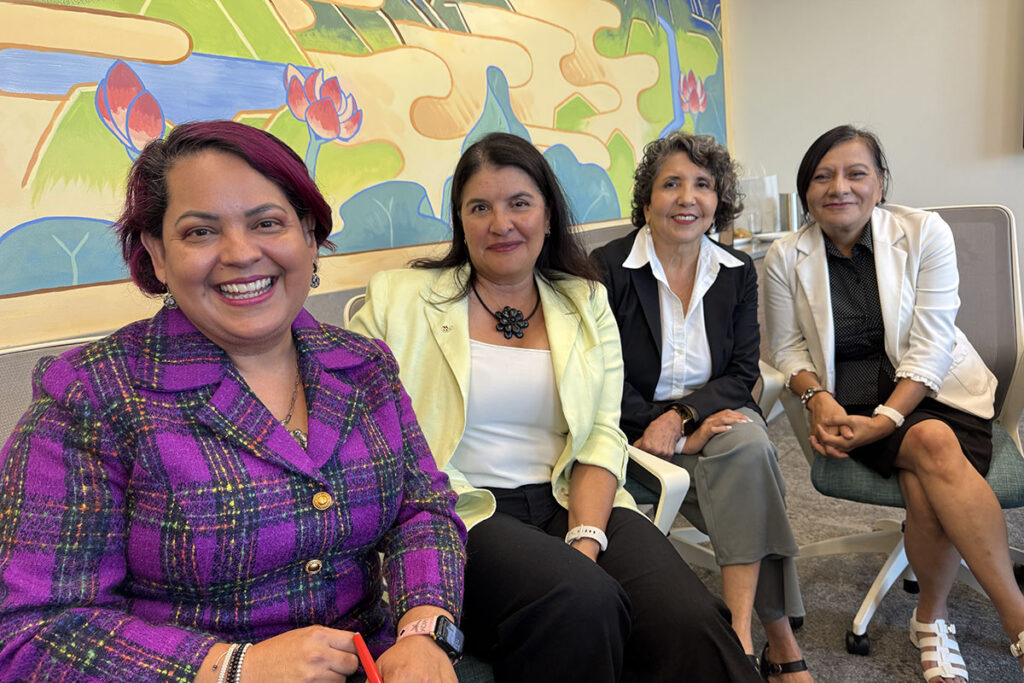
FOUR DIRECTORS | María González, Ale Spray, Ángeles Ortega, and María Zubia. (Photo / El Comercio de Colorado)

DIALOGUE ON THE STATE OF THE LATINO COMMUNITY
As part of Hispanic Heritage Month, El Comercio de Colorado convened four executive directors to analyze the challenges facing the Hispanic community. Moving beyond fear, embracing digital training, pursuing business professionalization, and advocating for key causes, these leaders outline a roadmap to transform Latino effort into real wealth and influence. A similar gathering with these executive directors took place in 2021.
By Jesús Sánchez Meleán
Haga click aquí para leer la versión en español
Five years after the initial impact of the pandemic, the headquarters of the Colorado Health Foundation opened its doors for a dialogue with the executive directors of four organizations that have a major impact on the Latino community. María González from Adelante Community Development, Ángeles Ortega from Mi Casa Resource Center, Alejandra Spray from Hispanic Contractors Colorado, and María Zubia from Amigos de México discussed the present and future of Latino families in the state.
With data in hand
González began by asserting that the biggest obstacle facing the Latino population today is an aggressive “political pandemic” in which resources are cut and the credibility of this community’s economic contribution is disqualified. The leader of Adelante Community Development emphasized that when negotiating with mayors and legislators, one cannot show up with hesitation; instead, one must bring hard proof (“the horse’s hairs in hand”), presenting compelling data on the financial impact generated by small Latino businesses.
Under González’s leadership, Adelante has recorded tangible progress demonstrating the sector’s potential when provided with adequate infrastructure. González explained how demand for business training at her organization surged by four hundred percent following the approval of new legislation in Colorado that streamlines permitting for food trucks across the state. Likewise, González highlighted that entrepreneurs understand the necessity of adopting technology to benefit their businesses.
“Eighty percent of our clients are already actively training in artificial intelligence tools and commercial digitization,” González said. According to her analysis, “the true engine of this transformation lies with Latina women, who receive eighty percent of our consultations. Importantly, Latinas do not limit themselves to opening just one business, but rather two or three simultaneous ventures, becoming fully independent financial pillars,” she states.
Dignity and support
Zubia outlined the reality faced by thousands of vulnerable families in the state. “Every two weeks, Amigos de México opens digital registration for its food bank, and the two hundred available slots to assist families fill up in just fifteen minutes. We know there is great need,” she shared. However, the director noted that she must deal daily with the paralyzing barrier of fear caused by the current political climate, which prevents many people from seeking essential resources they could receive.
Facing this scenario, Zubia firmly defends a human-centered working model where aid is delivered with absolute respect and dignity. Regarding technology, she observed that while some sectors of the population are soaring in the digital realm, others are still “at the crawling level”. Nevertheless, Zubia emphasized the willingness to embrace technology: “One of our clients, without speaking Spanish or English, managed to communicate fluently using the voice translation feature on her cell phone”.
Prepared to generate profits
Ortega focused on the educational and IT gap holding back Latino business growth. The director of Mi Casa Resource Center warned that “the pandemic left the community running behind compared to the rest of society in terms of limited access to computers and digital tools”. She questioned why many entrepreneurs “invest thousands of dollars in work trucks or expensive boots, but hesitate when allocating between one and two thousand dollars for a laptop,” she noted.
The director continued, “Without a computer, it is impossible to submit bids or formal proposals to win major corporate or government contracts”. Ortega pointed out the need for entrepreneurs to become aware of the importance of preparing and educating themselves. “There are those who make tamales at a cost of $3 and sell them for $3.25, without calculating the value of their own time, electricity, or gas. Those entrepreneurs need to learn tools to succeed,” she stated.
She shared that she has seen “construction subcontractors receive advance payments of $10,000 thinking it is all profit, only to face devastating tax debts later due to a lack of accounting advice”. In response, Mi Casa has established strategic partnerships with community colleges to expand educational offerings for entrepreneurs. “Supporting Latino businesses yields benefits. Businesses we have advised have generated $12 million so far in 2026. That benefits all of Colorado’s economy”.
Financial mindset
Spray reiterated the importance of developing a financial mindset. “Hispanic entrepreneurs often possess exceptional technical mastery as electricians or plumbers, but lack training in risk management, insurance, surety bonds, and profit margins. This gap causes services to be undervalued, such as when a contractor quotes a $25,000 job calculating only the cost of materials plus an additional ten percent, giving away their labor and risking bankruptcy,” she states.
Likewise, the director of Hispanic Contractors was emphatic about the necessity of learning English to conduct business on a large scale, pointing out that federal safety inspections and Occupational Safety and Health Administration (OSHA) regulations are written in English. In terms of community solidarity, Spray invited people to look at neighborhoods like Montbello as a benchmark, where African American groups have united to acquire entire buildings for their own people. “Initiatives must be considered to make Latinos competitive”.
United to multiply community wealth
The dialogue concluded with a collective reflection on the economic and political power that the Latino community must fully assume. María González recalled that “while in the Asian community a dollar circulates eleven times within the same neighborhood, and in the Jewish community it circulates ten times, in the Latino environment money barely changes hands twice before leaving”. This metric highlights the urgent need to support local small businesses and sustain the institutions forming the community fabric.
All four directors agreed that resilience should not be a sentence to perpetual struggle, but a springboard toward formal, educated, and prosperous participation in the global economy. The message emanating from this meeting is emphatic: “The Hispanic community in Colorado possesses the workforce, passion, and talent required to lead the state’s development, demanding the resources it deserves and building a legacy of collective wealth and lasting independence,” González concluded.
You may also like:
Archbishop Golka: “The Church stands with immigrants”
Guest Column – Evans: “My Mom taught me what the American Dream means”



otras noticias
Guest Column – The Hornet’s Nest Has Been Kicked Open
Latinos in Aurora Demand an End to the Rising Cost of Living and Raids
Latina Voters Demand Halting Inflation, Slashing Regulations, and Reforming the Immigration System