
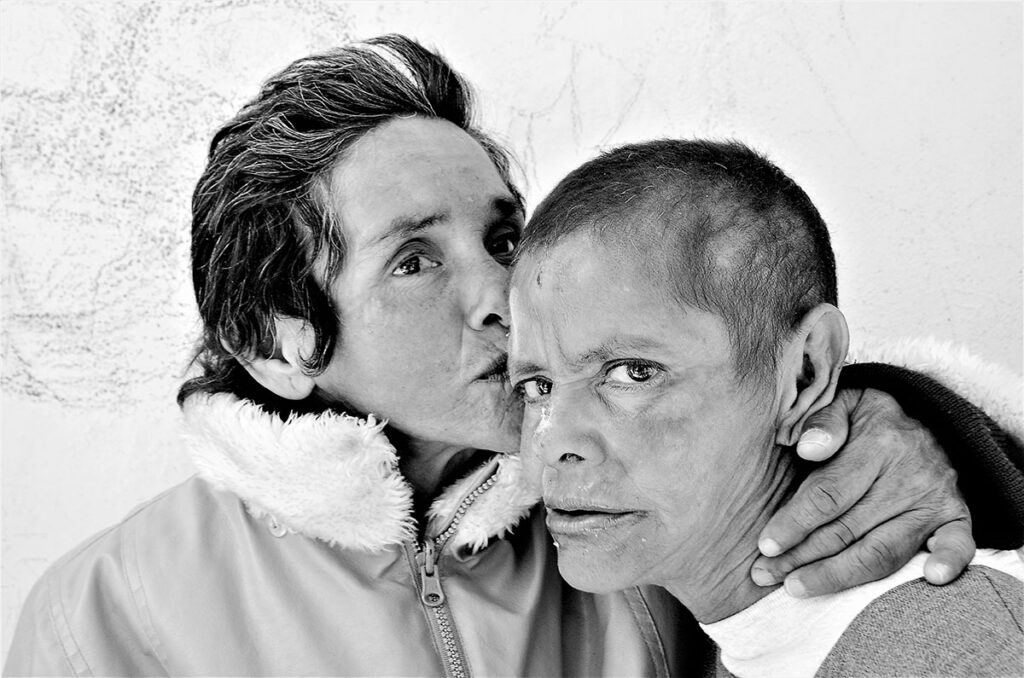
TWO SISTER| Elia y Leticia Zoto in Vision in Action. (Foto/ Morgan Smith)
Morgan Smith
Haga click aquí para leer la versión en español
Colorado ranks only 41st of the 50 states when it comes to mental health services according to Mental Health America. In New Mexico, legislators and the Governor have about one billion dollars and they are still trying to unravel the damage caused by ex-governor Susana Martinez back in2013.
This is bad news but it could be worse. We could be like the area on the west side of Juárez where I work with a number of humanitarian groups and where medical care is almost non-existent. What can be done? Here are several innovative approaches led by volunteers.
Vision in Action
Vision in Action is a mental asylum, founded by a former addict named José Antonio Galván. It cares for roughly 120 patients and has survived without government funds for thirty-five years.
Galván was born in Juárez, got married there and then moved to California where he and his wife, Esther had two sons and two daughters. He found good paying work as a crane operator on large construction projects but got into drugs, broke up with his family and was deported back to Juárez where he lived as a street addict.
On January 6, 1986, while drunk he spotted a street pastor, went into a rage and hit the pastor on the head with his beer bottle. Bleeding, the pastor forced Galván to the ground. “It was like he held my head in a vice,” Galván says. The pastor prayed over him. “His blood was falling on me like the blood of the Lord,” Galván relates.
Medical Care in Mexico
This incident – what he has called a “divine moment” – changed him; he then determined to devote his life to caring for the mentally ill. He acquired this patch of desert on the west edge of the city with a few shacks on it. Piece by piece he began building this facility while also taking in more and more patients, many of whom were dumped on him by the police.
Now Vision in Action cares for roughly 120 patients, making this the largest facility for the mentally ill in Juárez, a city of about 1.5 million. Operating with almost no government support it has managed to survive for the last thirty -five years, a tribute to Galván’s persistence and ingenuity.
For example, there is no money to hire professional staff so most of the management is carried out by a small group of better functioning patients who receive small stipends when the money is available. Josué Rosales, in the photo with Pastor Galván, is an example. He too was born in Juárez and moved to California when young. He got caught up in gang life, ended up spending nine years in various California prisons and then was deported back to Juárez where he lived as a street addict.
Finally, Josué was hospitalized. The hospital, assuming he was about to die, had him dumped at Vision in Action. Other patients bathed and fed him for months while he slowly recovered. He then became a caregiver himself, got a nursing degree and has been the principal in-site nurse for the facility.
Siguiendo los Pasos de Jesus (SPJ)
Siguiendo los Pasos de Jesus (SPJ) is a Juarez-based NGO that is mostly known for building houses in this area. Founded 27 years ago by the dynamic , SPJ has built roughly 700 houses, using local labor and raising money mostly via its annual fundraiser at the El Paso Country Club.
When my wife, Julie died in 2016, her many friends contributed funds to build a home for a woman named Elvira Romero and her grandkids, Hector and Yeira Beltran. Although Elvira is now deceased, the home has been a powerful stabilizing force for these two grandkids. This is a lesson for all of us – a house to live in is like a foundation.
However, Fuller knows that housing isn’t enough; her goal for SPJ is to create a community. She has built: a library which has a video and computer room, two community parks, one for kids up to the age of 12 and another with a soccer field and a basketball court, a community kitchen, a sewing and tutoring room and a “mercado” where locals can buy and sell their goods as well as an exercise area.
Most important, she has established relations with the El Paso and Las Cruces medical communities. Doctors, nurses and medical students come to her clinic once a month to provide care for a community of mostly women and their children. I have seen the hope on the faces of these women as they waited for care that had previously been non-existent.
Medical Care in Mexico
This is not a mental facility but shows the cross-border care of this project.The third program was started about ten years ago by Lupe Ayala and her then-living husband, Beto. It’s called Punto Zero and It houses another 30-35 mental patients, taken care of by Lupe and her family.
She is fortunate because she receives assistance from a large Colorado non-profit named Mission Ministries which has renovated the kitchen and built a new bathing area. In addition, a Texas photographer named Art Moreno Jr. and his father have started a “hot dog day” there which has evolved into a fundraiser.
Medical care ought to be a right but it clearly isn’t either in the US or Mexico. In the US, we spend a staggering amount on medical care but get less than we deserve. In Mexico, the government spends almost nothing but extraordinary people improvise and end up with much more than what you would expect.
This has to change eventually but you have to give great credit to those like José Antonio Galván, Jane Fuller and Lupe Ayala for what they do.
You may also like:
Colorado community pays emotional tribute to legendary business and Hispanic leader
Hispanic technology entrepreneur seeks to lead Boulder’s future
Evans: “Conditions at GEO in Aurora Are Superior to What I Had When I Served in the Army”

otras noticias
Governor Polis Appoints María González to Fill Manny Rutinel’s Vacancy
Hispanic leaders drive a leap toward prosperity in Colorado
Archbishop Golka: “The Church stands with immigrants”