
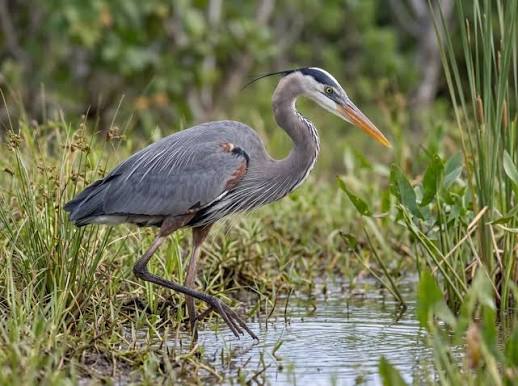
THE GREAT BLUE HERON (ARDEA HERODIAS)| This iconic bird of both Puerto Rico’s wetlands and Denver’s South Platte River serves as a vital bioindicator of aquatic ecosystem health amid climate change. (Courtesy/ Aves de Puerto Rico)
The opinions, beliefs, and points of view expressed by our guest columnists do not reflect the opinions, beliefs, and points of view of this publication.
What the dead seabirds of California are telling us in Colorado and Puerto Rico
By Irene Vilar, Author and Founder of Americas for Conservation, Health + the Arts
I grew up on the north coast of Puerto Rico, on wetlands filled with herons, less than a mile from the Atlantic. After school, my mother often took me to the shore to gather seashells and watch the seabirds. She loved the pelicans and the cormorants. She would laugh at the brown pelicans, all pouch and elbows, perched on the old pilings of the abandoned marina she liked to visit for the colorful fish swimming between the docks.
She would tell me to watch them take flight, because in the air the pelican became something else. Her passion taught me to follow them inches above the breaking waves, riding the lift of the swells with barely a wingbeat, until one of them climbed, folded its wings back, and fell headfirst into the surf from high up. She would applaud with joy and smile the most tender of smiles. My mother never tired of that plunge, and I never tired of watching her watch them. It was through her fascination that I learned to see them as fantastic creatures. My first lessons in birdwatching were taught by the wonder in my mother’s eyes.
My father belonged to the herons. His bird was the garzón cenizo, the great blue heron, which is the largest heron in Puerto Rico. It stood four and a half feet tall, all blue-gray stillness, with a black stripe drawn above the eye and a heavy yellow bill, and my father praised its size and its color each time we caught sight of one. He loved the way the bird held itself, motionless in the shallows for so long that you doubted it was alive, until it opened those enormous wings and rose with a slowness that seemed to belong to another world.
The great blues of Puerto Rico gather on the lagoons, mangroves, and wetlands of the north coast between October and March, and my father called Christmas the time of his garzón cenizo. Other children waited for the Three Kings. Thanks to my father’s love for the herons, I waited for the Kings and for a bird.
Neither of my parents would have said “bioindicator.” They knew anyway that where herons thrive the wetlands are alive, the mangrove nurseries are working, and the clean water is moving with abundant fish. Pelicans are sentinels of the sea in the same way. Where they gather in numbers, the sardines and anchovies are running. My parents loved sardines. When my father came home from work with a catch from his fisherman friend Don Toño, he would hand it to my mother and call out, sardinas para mi pelicana. She would feed them to me.
It is not a hard stretch to say my parents personified these birds of my childood. The heron is patience and balance, a sign of good fortune to whoever sees it standing in the shifting tide . The pelican is generosity. An early Christian legend says the pelican mother pierces her own breast and feeds her chicks with her blood, and for centuries people called that image the pelican in her piety. My mother taught me that the truth is hardly less astonishing. When we had sardines for dinner she often spoke of pelicans. Once she told me that In the first days the parent lays half-digested fish on the floor of the nest for the chicks that hatch, naked and blind. Soon the chick learns to thrust its whole head down the parent’s bill deep into the throat, to take the fish from inside the body that caught it. Mother and father take turns, one guarding while the other flies out to fish.
In time I came to learn that birds are messengers both in folklore and in science. My mother’s pelicans have carried a warning to us before. In 1970, when I was a year old, the brown pelicans of West Anacapa Island, off the coast of Southern California, made 552 attempts to nest and raised a single chick. A chemical plant in Torrance had been sending the pesticide DDT through the Los Angeles sewers into the Pacific since the late 1940s. The toxic chemical climbed the food chain from fish to bird and thinned the eggshells until the parents, who warm their eggs beneath their webbed feet, crushed their own young before they could hatch. That October the brown pelican was declared endangered.
Two years later, in 1972, the United States banned DDT. During my childhood years at the beach with my mother, neither of us knew that the birds we loved were only then being given back to the world. Slowly the colony on Anacapa returned, until the island held thousands of nests a year.
So I cannot read the news from California simply as a wildlife story. It is so much larger and all-encompassing than that. For months, my mother’s pelicans, Brandt’s cormorants and common murres have been washing dead onto beaches along much of that coast. State wildlife officials tested them for avian influenza and found starvation instead. Most are young and emaciated.
A marine heat wave has warmed the water up to eight degrees above average, and driven the fish deeper and farther offshore than a diving pelican can follow. A young pelican learning to dive needs fish near the surface, and the surface is where the heat is. Reports of chicks dead by the thousands are coming in from the offshore breeding colonies. The pelican plunge for sardines my mother loved has become, for many of them, a plunge into empty water.
What is the message? It is a very clear one. The ocean is running a fever, and the fever is ours. For more than a century we have burned coal, oil and gas, and the sea has quietly absorbed about ninety percent of the extra heat those emissions trapped. It spared us on land by taking the warming into itself, but now that heat is coming back to us. Scientists tell us that marine heat waves have roughly doubled in frequency since the early 1980s, and that they grow longer and hotter as the planet warms.
DDT was one chemical from one factory, and we stopped it. This time the pollutant is carbon, and the factory is our whole way of living. The lesson of Anacapa still holds. When we stopped the harm, the birds came back.
I write this from Colorado, a thousand miles from any coast, but the impacts ripple across the continent and the entire planetary home we share. The warming that empties a pelican’s pouch also lengthens our fire seasons, feeds the ozone, and thickens the air our children breathe, inflaming their developing lungs. The garzón cenizo is here too, standing in the shallows of our Denver’s South Platte with the same stillness my father loved, and still telling us whether the water is alive.
To lead in this conservation and environmental justice work is to accept the role of witness, and to witness is to refuse to scroll past and instead act. Wherever you are, support the rescue centers that are spending everything they have. Press those who represent us to treat ocean heat and climate change as the existential threat it is. This winter, join a Christmas Bird Count, the longest-running community bird survey in the country. Ordinary people, watching carefully, produce knowledge. It happens to fall in the time of the garzón cenizo.
Then do the simplest thing and take a child to the water. Have them watch you watch with love and wonder. That is how we learn to care.



otras noticias
Denver Labor secures $117,244
Guest Column – Love Thy Neighbor, at Scale
Latino Voters Demand Halt and Review of Healthcare Program Cuts