
Why a Colorado nonprofit carries three nouns in its name, and why I am asking you to stand with it on Colorado Gives Day
By Irene Vilar /
Author of The Ladies’ Gallery and Impossible Motherhood, founder and executive director of Americas for Conservation, Health + the Arts, and publisher of Mandel Vilar Press.
I was born in Arecibo, Puerto Rico, on an island where the land, the body, and the story were colonized together. Throughout decades of personal therapeutic work and professional experience, I have learned in multiple ways that you cannot repair one without the other two.
The lessons from this journey became a Colorado-born organization whose name is a mouthful: Americas for Conservation, Health + the Arts (AFC+A). As Colorado enters its season of giving, I want to tell you the origin story behind that name, and how its three words are held together by a truth most of us already know. The land we come from shapes our bodies, and our bodies carry our stories, and our stories are what tell us who we are and where we belong.
The land was taken in July of 1898 when American troops landed on our southern coast. By the end of that year, Spain had ceded Puerto Rico to the United States only one year after we had won a charter of self-government. In 1953, a year after the commonwealth constitution, the United Nations General Assembly voted to take Puerto Rico off its list of territories awaiting decolonization. In Vieques, the Navy took over half an island and used its coast for bombing practice for decades.
In the 1950s and 60s, the US military tested in our forests the herbicides that the world would come to know as Agent Orange. Barceloneta, the town where I grew up, sits inside one of the largest pharmaceutical complexes in the hemisphere. My town’s landfill is a federal Superfund site. Scientists have followed industrial solvents through the limestone aquifer of the north coast and shown the slow ecocide carried out in our water.
My mother, who was a leader of the independence movement in our town, used to take me to the ocean after school to watch the pelicans dive. My first lessons in loving a place came from her, who knew that the fate of that coast, its water and its air, was being settled in offices in Washington and in corporate boardrooms where no one from my island had a real vote. In her love for the land, nonetheless, I learned to belong. My grandmother, Lolita Lebrón, believed that what happened to Puerto Rico was her business. She spent some twenty-five years in prison for that belief. From my mother’s mother I learned to ask what it is worth to belong to a land if you are never asked what will be done to it.
The body was taken more quietly. Under a eugenics law passed in 1937, and through the decades of population policy that followed, about a third of Puerto Rican women of childbearing age were sterilized. By 1975, we held the highest rate in the world, in a procedure so common it had the household name of la operación. The coercive tactics of this abuse reached women through every door of their lives.
Health workers went house to house urging mothers of two to have it, hospitals offered it at the bedside right after childbirth, the family planning program opened clinics inside the factories, and employers offered work incentives to women who had been operated on. Many were advised to undergo radical hysterectomies after an abnormal Pap smear. The first large trials of the birth control pill were carried out on the women of my island, beginning in 1956, at dangerous doses many times what any woman takes today and at a time when no rules of informed consent existed.
My mother was one of the women whose bodies that era claimed. At thirty-three, she was sent home from a hysterectomy without hormone treatment and with a prescription for Valium, a pill manufactured in the pharmaceutical complex our town is part of. A year later, when I was eight, I lost her. I have come to read her despair and the despair of so many women of her generation, as part of what that policy left behind in our families. Our bodies do keep the score across generations.
The story was taken too. For the first half-century of American rule, our public schools imposed English as a language of instruction on children who did not speak it at home. School textbooks handed them a version of their own history and heritage written to serve the colonial project. In my grandmother’s time, a Gag Law made it a crime to fly the Puerto Rican flag or to speak for independence.
In my own family, silence did the rest. After my mother’s death, I lived as a guest in other people’s houses, learning to please and to not be trouble. What held me were nature and books. Nature came first, in the woods of Orford, New Hampshire, at an off-the-grid boarding school that ran like a kibbutz and where the students kept the place alive with their own hands.
There I learned the marvels of making honey and maple syrup, of milking cows and plowing the soil. In those New England forests, I discovered that land could be tended as well as taken, and that the hands that tend a place are learning, in the same motion, to tend the body they belong to. Books came next, in a convent school in Spain, where at twelve I read Anne Frank and Viktor Frankl and learned that I was not the only child to have had her world taken from her. In those books I learned that what outlasts such a loss is the meaning a person makes of it and the page where she writes it down.
At sixteen, I began to write. My first memoir, The Ladies’ Gallery, was written in Spanish and reached readers first in English translation, which is its own small lesson in how a Puerto Rican story travels. My second, Impossible Motherhood, followed the wound of la operación into my own body. Writing them taught me that when you tell your story, you stop being the subject of someone else’s.
When I became a mother, I wanted my daughters to inherit healing along with memory, and that wish became Americas for Conservation, Health + the Arts. People still ask why three nouns share one name, and the answer is the one my childhood gave me.
Conservation protects the place because a people without a coast, a forest, or a field of their own has nowhere to stand when they are asked who they are.
Health protects the body that lives in that place and pays for whatever is done to it, be the lungs of a child beside a highway or the womb of a woman in a clinic of the 1950s.
The arts protect the story without which a community cannot know that the place is theirs to know and protect.
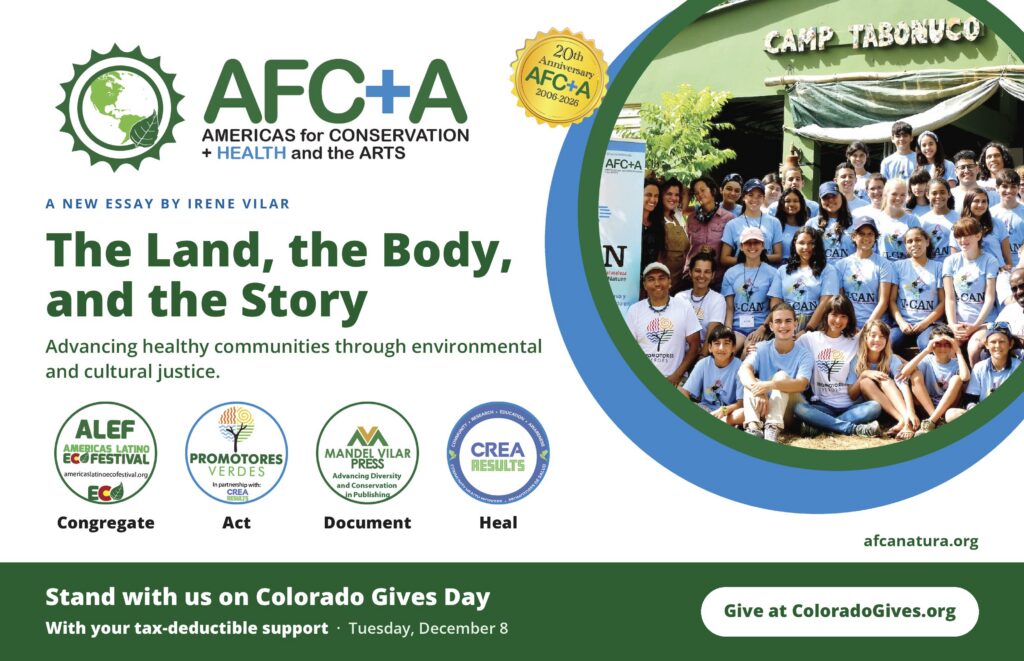
For two decades at AFC+A we have practiced all three mandates at once.
For the land, we have planted more than 1600 tress at family homes across Denver, Weld, and Adams counties, as well as in Mexico and Puerto Rico, where shade and clean air are unevenly shared. After Hurricane María, our Guagua Solidaria raised $1.5 million and helped rebuild 122 small agroecology farms in Puerto Rico.
For the body, our Promotores Verdes have prepared neighbors in Puerto Rico and Colorado, and more than 300 young people, to lead in environmental health and food sovereignty. Our LUNA and forest bathing gatherings since 2016 have brought more than 2000 people into forests and the medicine they provide. Our current RESPIRA Aire Limpio campaign teaches families to understand and defend the air their children breathe.
For the story, the Americas Latino Eco-Festival, now in its fourteenth edition, has seeded more than 200 collaborations across the Americas, and Mandel Vilar Press, our publishing house founded in 2014, has brought more than 150 books into the world, earned twelve awards, and taken two imprints and their long backlists under its care, so that voices kept at the margins of American publishing stay in print and within reach.
I believe a book is a democratic technology as surely as a tree is public health infrastructure, and at a moment when both are under pressure, I know of few organizations that hold the land, the body, and the story in one pair of hands.
This past year tested us. Climate and DEI-led grants we had earned were cancelled, but we kept working anchored in our social capital and volunteerism. What we need now are people who will stand with us for the next twenty years.
Colorado Gives Day is Tuesday, December 8, and giving is already open. A tax-deductible gift of any size helps plant trees in a treeless neighborhood facing life-threatening heat, train and support a community health worker and our promotores verdes, or keep a book in print and advance a more equitable and diverse publishing economy.

otras noticias
Omar Montgomery Launches Candidacy to Govern Aurora on December 6
Guest Column – The Day After Fifty-Six
Guest Column – The Time of the Garzón Cenizo